PK

Prince Kumar Gupta

Verified

Founder & CEO | AI Automation Consultant | Full-Stack AI Developer

14posts
5networks
Work with Prince

Prince Kumar Gupta is a Founder, AI Automation Consultant, and Full-Stack AI Developer who designs and ships end-to-end AI agent systems and workflow automations for businesses. He operates at the intersection of practical AI engineering and strategic consulting — turning manual business processes into intelligent, self-running pipelines. His brand is builder-first: credibility comes from deployed systems, not theory.

Known for

Artificial IntelligenceAI AgentsGenerative AIWorkflow AutomationFull-Stack DevelopmentREST APIsCloud ComputingSoftware ArchitecturePrompt EngineeringBusiness Automation

Notable work

Contributed as a Full-Stack Developer to "Aastrika Sphere," a Healthcare LMS Platform for the Aastrika Foundation supporting Designed and developed AI-powered applications, intelligent automation systems, and scalable web platforms for startups and businesses. Experienced in building AI agents, workflow automation solutions, enterprise software, REST APIs, and cloud-based applications. Passionate about applying Artificial Intelligence to solve real-world business challenges and improve operational efficiency.

Find Prince online

Recent posts

🛑 I turned down a project last month. The client wanted an autonomous agent to make high-stakes decisions with zero human review. I said no. Here's why that matters more now than it did a year ago. Illinois just became one of the first states to regulate large AI model developers. The law requires annual independent third-party audits. And any "catastrophic risk" incident, think death or over $1M in damage, has to be reported within 72 hours. 72 hours. That's the new clock. So when a client asks me to ship an unsupervised agent that touches money, health, or safety, "no" isn't me being difficult. It's me protecting them from a liability they can't see yet. The turn came when I realized my job isn't to build whatever's technically possible. It's to build what won't blow up on you in six months. The best thing I can hand a founder is sometimes a smaller scope, a human in the loop, and an audit trail baked into the workflow from day one. Boring. Defensible. I'd rather lose the deal than lose your trust when the regulator calls. The consultants worth paying are the ones who tell you what not to build.

View original →

📊 Gartner says agentic AI will disrupt up to $234 billion in enterprise application software spending by 2030. Most people read that as a market forecast. It's not. It's a warning about how you deliver value. Here's what's actually happening underneath the number: 1. Agents don't need your UI. When a system can act on its own, the dashboards, forms, and click-paths that most SaaS products charge for stop being the product. 2. That breaks per-seat pricing. If nobody logs in, what exactly are you billing seats for? 3. The value moves from the interface to the outcome. Software that closes the loop wins. Software that just displays data becomes a line item someone cuts. I build these systems for a living, and the shift is real. A client of mine replaced three internal tools with a single agent workflow. Nobody opens the old apps anymore. The renewals didn't survive the quarter. So the $234B isn't spend that vanishes. It's spend that relocates, from software you look at to software that does the work. If your product still assumes a human sitting in front of a screen, that assumption is the thing to re-engineer first.

View original →

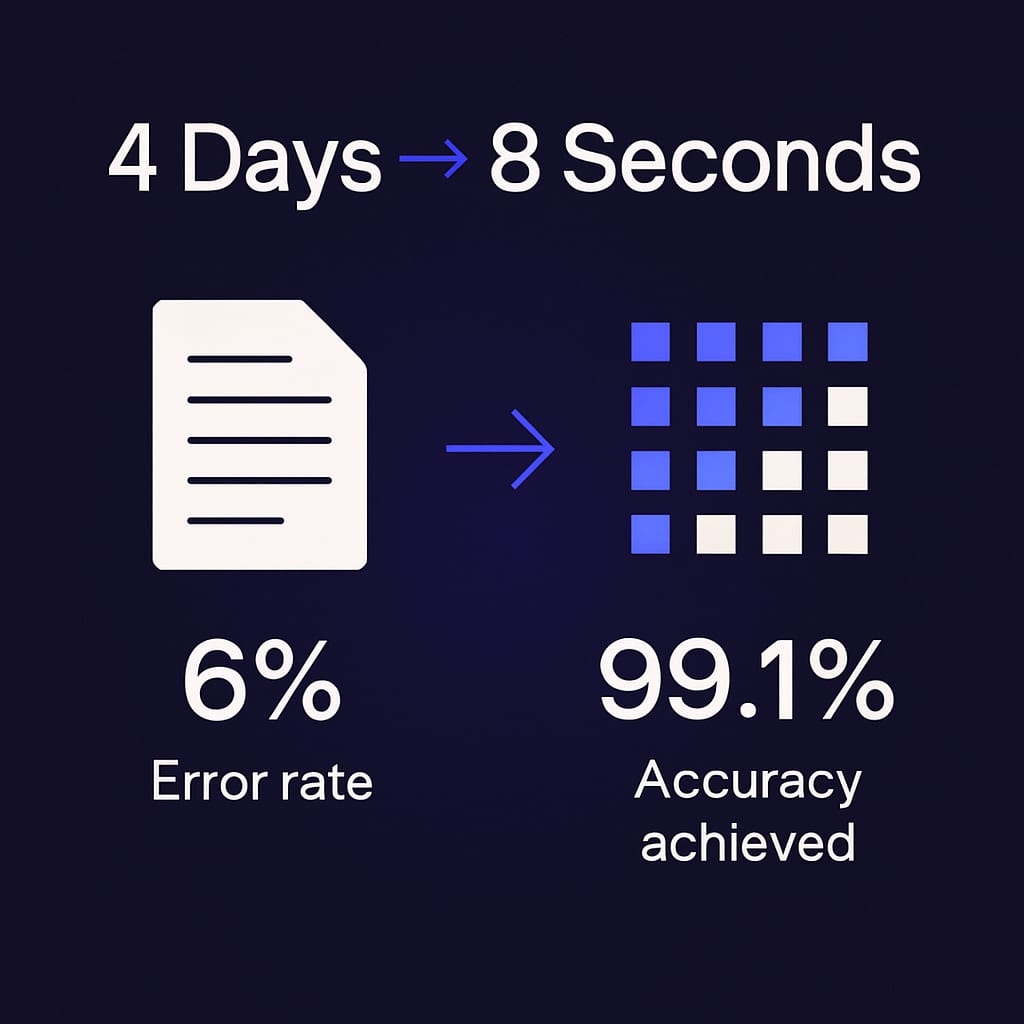
💸 A client spent 4 months and roughly $60k on an "AI transformation" and had nothing in production to show for it. Beautiful whiteboards. A demo that got applause in the boardroom. Zero workflows actually running. When I audited it, the problem wasn't the tech. It was that nobody had picked a single painful, measurable process to automate first. They'd started with the vision instead of the invoice. So we killed the roadmap and shipped one thing: their invoice-matching flow. n8n pulling POs, an OpenAI call to reconcile line items against receipts, FastAPI writing back to their ERP. Two weeks. One workflow. It cut a 6-hour daily task down to about 20 minutes of human review. That's the number the CFO cared about, not the demo. Here's what I've learned building these: ROI doesn't come from the model. It comes from choosing the boring, repetitive, expensive process nobody wants to touch, and shipping it end to end before you touch anything else. Demos impress the room. Deployed systems change the P&L. If your AI initiative can't name the hours or dollars it saved this month, it isn't an AI initiative. It's a science project.

View original →

🚀 I shipped an AI system last Thursday that a client had been "planning" for seven months. Seven months of decks. Vendor calls. A Notion board with 40 tagged "ideas." Zero lines of code in production. I get why it happens. AI feels risky, so people study it instead of building it. Endless workshops feel like progress. They aren't. We scoped one workflow: their support team was copy-pasting order data between three tools, roughly 2 hours a day. In 48 hours I had it running. n8n for the orchestration, OpenAI for the classification, a thin FastAPI layer to talk to their CRM. Not perfect. It misrouted maybe 1 in 20 tickets on day one. We fixed that by Friday. The lesson I keep relearning: a rough thing in production teaches you more in a week than a perfect plan teaches you in a quarter. Ideation gives you the illusion of momentum. Shipping gives you data. I'd rather debug something real than admire something imaginary. That's the whole job. The best AI project isn't the smartest one on the roadmap. It's the one that's actually live by Friday.

View original →

⚙️ My first "autonomous" agent worked perfectly in the demo and fell apart in week one of production. It booked a duplicate meeting. Then it hallucinated a client's invoice number and sent it. Same afternoon. The demo agent and the production agent are two different animals. Nobody warns you about that gap. Here's what actually closed it for me: 1. Guardrails before intelligence. Every tool call now passes through a validation layer that can reject the agent's own output. Most failures aren't reasoning failures, they're the agent doing exactly what you asked in a way you never imagined. 2. Retries with memory, not blind loops. I log every failed step to a state store so the agent knows what it already tried. Without this, agents cheerfully repeat the same broken action 40 times and burn your token budget. 3. A human checkpoint on anything irreversible. Sending money, deleting data, emailing a client. The agent drafts, a person approves. Boring. Also the reason clients trust it. The uncomfortable truth: getting an agent from 80% to 99% reliable is harder than building the first 80%. That last stretch is where the real work lives, and where almost everyone quits. I build these systems for a living, and the production stage is where I earn my keep. Not the demo. Save this for the next time a slick agent demo makes something look easy.

View original →

⚖️ Illinois just made "72 hours" the number that should scare AI builders. The state passed one of the first US laws regulating large AI model developers. Not a framework. Not a task force. Actual law. Two things sit inside it that hit engineering, not just legal: 1. Annual independent third-party audits for large AI developers. Someone outside your org gets to open the hood. 2. Catastrophic risk incidents (a death, or $1M+ in damage) must be reported within 72 hours. Read that second one again. 72 hours means your logging, tracing, and incident detection have to already be good enough to catch a "catastrophic" event, classify it, and package it for a regulator. Fast. Most teams I talk to can't reconstruct what their agent did last Tuesday, let alone within three days of a live incident. That's the real cost here. This isn't a compliance checkbox you bolt on later. It's observability, audit logs, and eval pipelines you build in now, or pay for painfully later. In my work building AI agents and automation, the systems that survive scrutiny are the boring ones: every decision logged, every tool call traced, every model version pinned. State-by-state rules are coming. Illinois is just first. Build the audit trail before the auditor asks for it.

View original →

🔧 I've shipped models with 94% offline accuracy that fell apart in production within a week. The model wasn't the problem. The pipeline was. A timestamp column silently changed format upstream. Nobody noticed for four days. The model kept scoring, confidently, on garbage. Here's what actually breaks in production: Schema drift no one flagged. Late-arriving data the model never saw in training. A feature that was 2% null in dev and 30% null live. The turn came when I stopped treating the pipeline as plumbing and started treating it as part of the model. Data validation checks. Freshness monitors. Alerts that fire before the prediction does, not after the client complains. Gartner now predicts agentic AI will disrupt up to $234 billion in enterprise application software spend by 2030. Agents that act on their own data are only as trustworthy as the pipe feeding them. A shaky pipeline doesn't just tank accuracy. It hands a bad decision to a system with no human in the loop. In my consulting work, I spend more time hardening data flows than tuning models. It's less glamorous. It's what keeps the thing alive past week one. Brilliant model, broken pipe, dead system. Every time.

View original →

🛠️ I ignored 90% of the AI tools that launched this quarter. My stack got faster, not slower. Nobody says out loud: most "must-try" launches are a wrapper on the same three model APIs you already use. So I run every new tool through the same filter before it touches a client build: ✅ Does it remove a step I'm currently doing by hand, or just rename it? ✅ Can I self-host or export my data if the startup dies in 8 months? ✅ Does the demo work on MY messy input, not their cherry-picked one? ✅ Is it cheaper than the 30 lines of code it would replace? If it fails two of those, I close the tab. Real example: last month I almost swapped my n8n + FastAPI setup for a shiny "autonomous agent platform." Ran a client's actual invoice data through it. It choked on the first edge case. My boring pipeline handled it in one retry. The winners aren't chasing every release. They pick a stack, learn it deeply, and only swap when something genuinely earns the slot. Noise is optional. Depth compounds.

View original →

🛠️ A client showed up with a 40-slide deck last month. Grand vision. Autonomous agents everywhere. Zero of it ran. That's the pattern. Founders arrive with a story about what AI will do for them. Beautiful decks. Big promises. My actual job starts where the deck ends. Take that same client. The "vision" was an AI agent that handled inbound support end to end. The real work? A retrieval layer over their messy Notion docs, a FastAPI service to route tickets, guardrails so it stopped hallucinating refund policies, and an n8n flow to escalate anything it wasn't sure about. None of that fit on a slide. All of it is what made the thing usable. We shipped in 11 days. It now resolves 60% of tickets before a human sees them. Here's what I've learned building these: a vision is a hypothesis. A system is proof. The gap between them is edge cases, latency, and the boring plumbing nobody demos. I don't hand clients a strategy doc. I hand them something that runs in production and shows up in their metrics. The deck impresses the board. The system pays for itself.

View original →

🤖 Most "autonomous agents" I audit are just if-else chains wearing a trench coat. I say this as someone who ships them for a living. The tell is simple. Give the system a task it wasn't explicitly designed for and watch what happens. An orchestrator breaks or asks you. An agent reroutes. Here's the line that actually separates the two: 1. State. An orchestrator holds a checklist. An agent holds a goal and rebuilds the plan when the world changes. 2. Recovery. When an API 500s, a task runner throws. An agent retries, swaps tools, or picks a different path to the same outcome. 3. Judgment. An orchestrator follows the branches you hardcoded. An agent decides which branch should exist. Last month I rebuilt a client's "agent" that scraped invoices. It was a linear n8n flow. One vendor changed their PDF layout and the whole thing silently dropped 40% of records for two weeks. We wrapped it in a real LangGraph loop with a verification step that checks its own output against expected totals. Now it flags the anomaly instead of eating it. That's the difference. Not the model. The loop. Most people are buying autonomy and shipping automation. Both are fine. Just know which one you actually built before you promise a client it thinks.